
Fayette Crime News Sources
Fayette County has a compact local news scene. The real anchor is the Fayette County Sheriff's Office and its current-custody portal, not any newspaper story. The portal can show who is held in the jail right now, and it may display a mugshot when one sits in the record. It is not a news archive, though. It is not a same-day list of every arrest, and it does not promise a photo for every booking. Someone who was cited, released fast, transferred, or never booked into FCSO custody may simply be absent.
For local reporting, the Fayette Falcon stands out. Its Breaking News and Tennessee News sections carry coverage of the area. The Falcon is a weekly Somerville paper that also runs a standing sheriff-report feature. Its stories add useful context. Still, only sheriff and court records can confirm a live booking or what a case became later on.
Fayette News Outlet Details
The table sorts the official custody route away from local reporting and the two verified third-party Fayette County pages. Official sources lead the list for a reason. The sheriff verifies current custody. Full stop. A newspaper story or third-party page can preserve helpful details, yet neither holds the record the way the sheriff or the courts do.
| Outlet | Coverage | Photos? | Where |
|---|---|---|---|
| Fayette County Sheriff’s current-inmate portal | Official current county custody, not editorial crime coverage. | May display when the portal record supplies a mugshot. No guarantee applies to each entry. | Current Inmates |
| Fayette Falcon | Local stories plus a weekly Sheriff’s Report with an intake-and-release window. | The sampled report is a text table, not a booking-photo gallery. | Breaking News |
| Busted Newspaper | Unofficial Fayette County publisher/index with mixed custody timing. | Can display a booking photo when its source record supplies one. | Fayette County page |
| Mugshots.com | Unofficial Fayette County publisher/index, not a current-custody roster. | Can display booking-related images and descriptive fields. | Fayette County page |
Only Busted Newspaper and Mugshots.com run confirmed Fayette County, Tennessee pages. Keep their limits in mind. A timestamp there confirms nothing official. A custody status on a third-party site could mean someone was just booked, is still held, or has already walked out. A missing page says nothing definite either way about a booking.
The Mugshots.com Fayette County page appears here simply as an example of a clearly labeled secondary publisher.
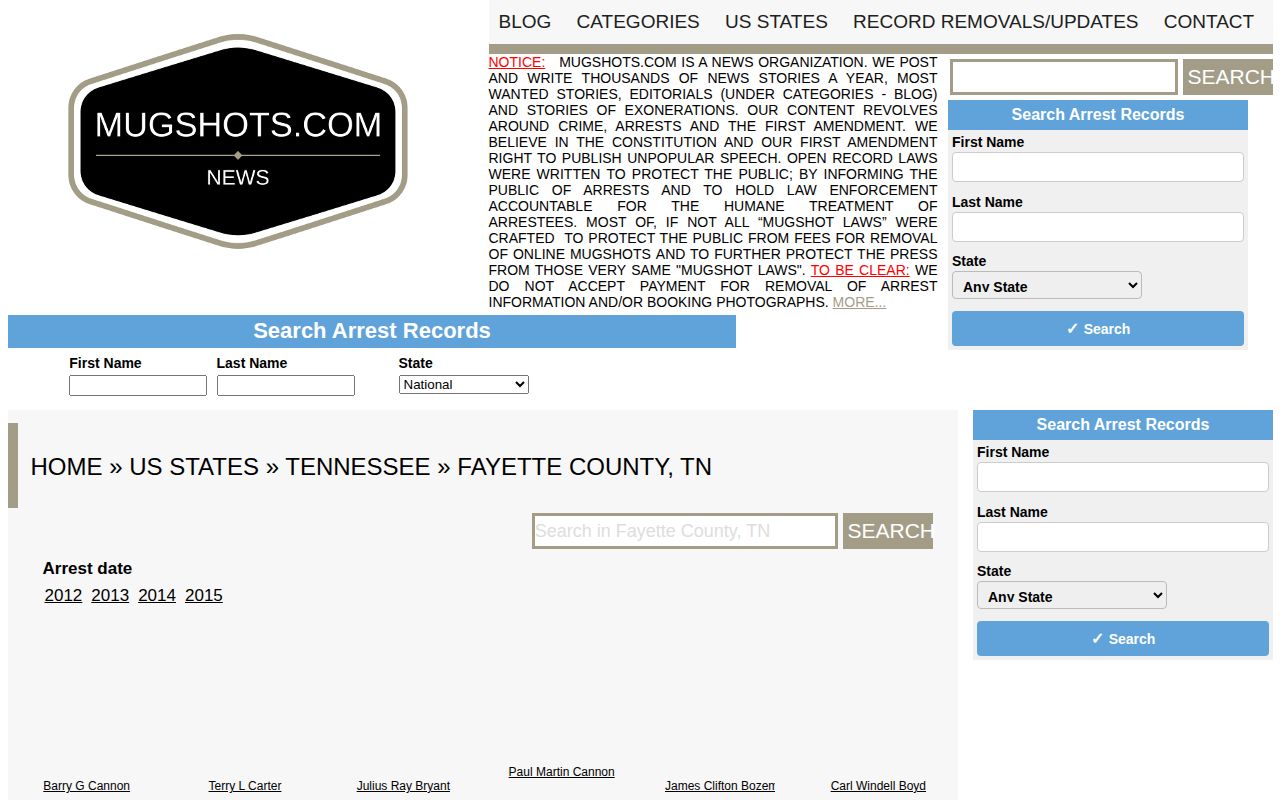
An indexed listing like that one cannot prove current custody, full coverage, or how a case ended in court. Go to the official roster first. Check the court files next. They answer the questions a third-party page can only hint at.
Fayette Falcon Booking Reports
The Fayette Falcon's recurring sheriff report is the county's most unusual bridge between news and records. One February 2025 issue carried the heading "Fayette County Sheriff's Report, Intakes & Releases 2-4-2025 thru 2-11-2025." That window matters. It captures both people brought in and people let go during the week. The live FCSO roster works differently. It tracks only current county custody and shifts whenever someone is released or moved.
The Falcon's table lists names, booking and release dates, arresting agencies, and charges. No photos accompany the entries. The intake lines credit a wide range of agencies, including FCSO, Oakland Police, Somerville Police, Tennessee Highway Patrol, and other government offices.
A weekly issue can help you pinpoint when someone dropped off the current custody list. Just remember what it is. It is a newspaper's copy of agency information, not a complete sheriff archive. For a defined stretch of history, a specific records request to FCSO beats assuming the paper caught every event.
Note: The Falcon combines intakes and releases in one report, so appearing there does not mean a person is still in Fayette County custody.
Fayette Booking Photos in News
No Fayette County Sheriff's Office policy promises a booking photo will reach the press or appear with every arrest. The official inmate interface shows a mugshot when the record holds one. That is not a blanket publication rule. A missing image does not prove no photo exists. A photo on some unofficial page proves nothing about custody or a case outcome.
The Falcon sample argues for careful wording too. Its Sheriff's Report is pure text and tables. There is no booking-photo gallery, and no recurring Fayette photo-release practice has surfaced. For a specific booking record or image, the cleanest route is a narrow request to FCSO Records asking whether the item is kept and can be released.
For an adult booking, Tennessee's public-records framework can back a specific request, subject to exemptions and lawful fees. That does not put every photo online. Juvenile, sealed, expunged, and protected material plays by entirely different rules. Never guess at it from a news search.
Trace Fayette News to Records
Start with the story itself. Jot down the arresting agency, the date, the exact name spelling, and any booking or case number. Those small details do the heavy lifting. They separate an in-custody event from a later report on the same incident, and they keep you from chasing the wrong person entirely. The county-wide booking and records path covers the current-roster and records-request channels in fuller detail. From there, keep each custodian in its lane. The jail holds custody facts. The courts hold case files. The newspaper holds only what it printed that week.
- Read the story for the agency, date, name, and stated charge. Treat every charge as an charge.
- Check the official FCSO current-inmate portal if the report indicates a Fayette County jail booking. A result addresses current custody, not a final case outcome.
- Request a specific booking record from FCSO Records when a historical or released-person record is needed. Include the name as booked, approximate date, and arresting agency.
- Contact the Fayette Circuit Court Clerk for the case file, hearing information, or disposition. Provide a case number when available.
- Compare dates and agency fields before drawing any conclusion. A release from the roster and a court disposition are different events.
This approach also sidesteps a common trap. Someone can show up in a newspaper story, land in a weekly intake table, and walk out of custody days before anyone checks the portal. Three records, one person, three different moments. All of them can be perfectly accurate at once. The error comes from treating them as snapshots of the present rather than points along a timeline, which is why source details matter before you compare anything.
Fayette Court Record Outcomes
Jail records stop at the cell door. They tell you who was booked and who is in custody. That is where their job ends. Court files pick up the story from there, tracking a case through first appearance, bond review, arraignment, preliminary hearing, indictment, plea, dismissal, nolle prosequi, acquittal, conviction, sentencing, probation, or transfer. Keep one thing in mind when comparing the two. The charge in a booking or news account reflects a single stage. It may look nothing like the final disposition.
For court-file and disposition questions, the Fayette Circuit Court Clerk is the office to contact. No public countywide online search covers the trial courts. Requests go through the clerk directly. Municipal matters belong with the relevant city court clerk instead. Either way, bring a name, a case number if you have one, an approximate filing date, and the court involved. Clerks work faster with specifics.
Fayette Cross-Agency News Lines
City-only searching will miss county bookings. The Falcon sample shows why. Its sheriff-report intake lines pull from FCSO, the Oakland Police Department, the Somerville Police Department, the Tennessee Highway Patrol, and several other agencies at once. That makes the arresting-agency field the most useful reconciliation detail in the record. It names the office that started the event. The jail, the newspaper, and the court each hold a separate slice of what came after.
Oakland, Somerville, and Piperton run their own police and municipal processes. None of the three offers a public arrest-photo feed. When a qualifying city arrest moves into FCSO custody, the county portal becomes the place to check current status. A city police report, a county booking record, and a court file can all describe one event without being interchangeable documents. Keeping them straight prevents a county booking from being pinned on the wrong agency, or a city report from being read as proof of a court outcome.
Note: The arresting-agency label marks the intake source, not which court later takes the case.
Fayette Local Third-Party Pages
Beyond the official portal and the court route, two third-party pages offer a limited secondary picture of Fayette County bookings. Busted Newspaper's Fayette page can list a name, age or date-of-birth fields, sex or race fields, booking date, charges, bond, and a booking photograph when its source record supplies them. The time window is mixed. A listing may involve someone in custody now, recently released, or long gone. The page is neither the FCSO roster nor a guarantee of complete coverage.
Mugshots.com's Fayette page is another unofficial publisher and index. Its visible count reflects whatever a crawl picked up, not a current jail population or a full historical total. Entries can mix present and past custody states. Nothing on the page confirms that a record still matters today. Check both publishers against FCSO and the courts, especially when an entry is old, corrected, sealed, expunged, or tied to a changed disposition.
Neither page filters by city. An Oakland, Somerville, or Piperton connection should come from the entry's own agency or city information, never from the mere fact that it sits on a county page. The local presence is worth documenting. Still, official records lead. Court dispositions settle what the record finally means.